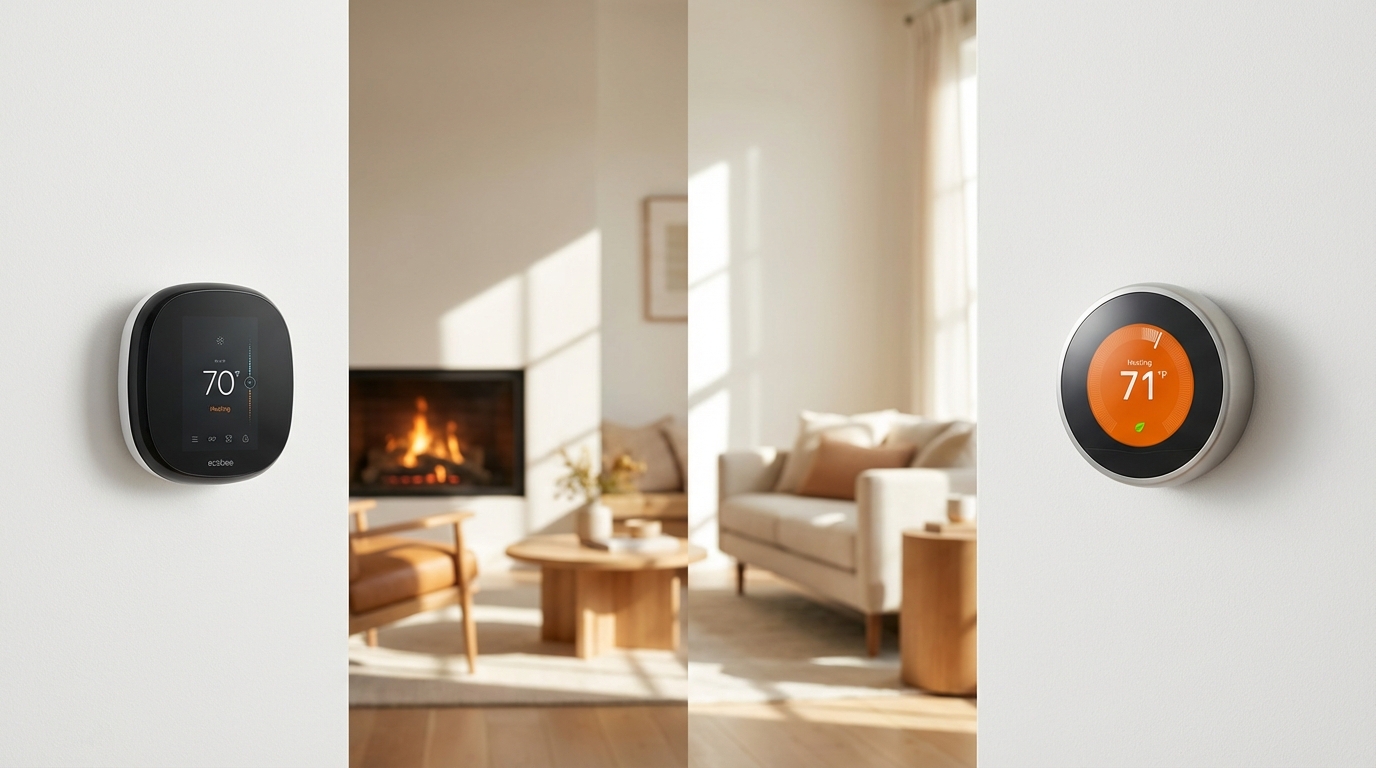
Choosing between an Ecobee and Nest thermostat is one of the most common dilemmas for anyone upgrading to a smart home. Both brands dominate the smart thermostat market, but they take surprisingly different approaches to saving you money and keeping your home comfortable.
If you’re wondering which thermostat deserves a spot on your wall, you’re in the right place. This comprehensive guide breaks down the ecobee vs nest thermostat debate across every factor that matters—from price and features to compatibility and long-term value. By the end, you’ll know exactly which smart thermostat fits your home, budget, and lifestyle.
Quick Comparison Overview
Before diving deep into specifics, here’s how these two smart thermostat giants stack up at a glance:
| Feature | Ecobee (Smart Thermostat Premium) | Nest Learning Thermostat (4th Gen) |
|---|---|---|
| Price | $249 | $279 on Amazon |
| Room Sensors Included | Yes (1 sensor) | No (sold separately) |
| Voice Assistant Built-in | Alexa | Google Assistant |
| Learning Capability | Limited | Advanced AI learning |
| Smart Home Integration | Excellent | Excellent |
| Touchscreen | Yes | Yes |
| Energy Reports | Detailed | Simplified |
Both thermostats can significantly reduce your energy bills—most users report 10-23% savings on heating and cooling costs according to manufacturer data and user reviews.
Design and Display: First Impressions Matter
Nest’s Iconic Aesthetic
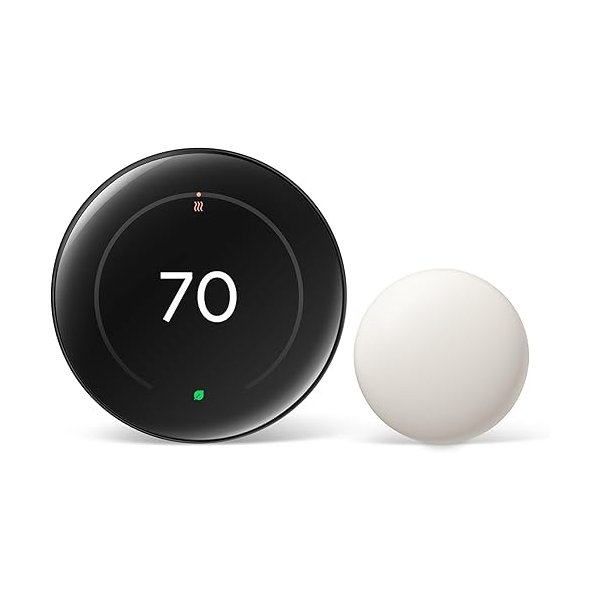
The Nest Learning Thermostat has maintained its signature circular design since launch, and it’s become iconic in the smart home world. The 2026 model features a larger, brighter display that shows weather, temperature, and time at a glance. According to user reviews, the mirrored finish integrates seamlessly into modern home decor.
The device uses a rotating dial for navigation, which many users describe as intuitive and satisfying to use. When you’re not interacting with it, the display dims or shows ambient information like weather forecasts.
Ecobee’s Functional Approach
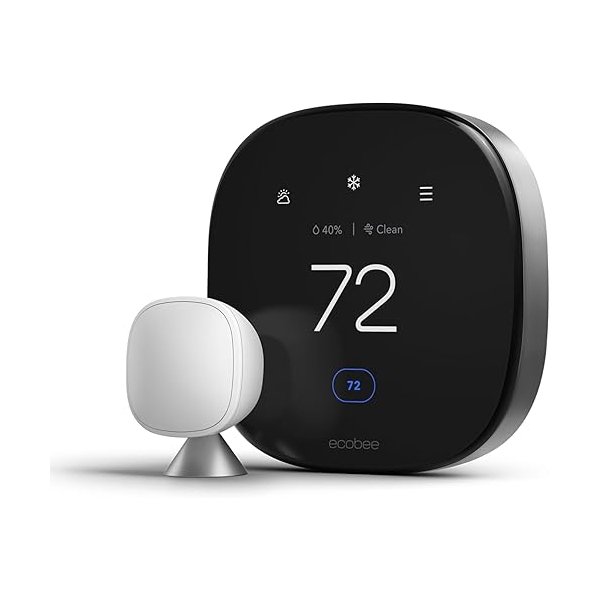
Ecobee takes a more straightforward approach with a square touchscreen design. The Smart Thermostat Premium features a 3.5-inch full-color LCD that’s easy to read from across the room. The interface resembles a smartphone, making it immediately familiar to most users.
One standout feature: the built-in air quality monitor shows readings directly on the home screen. User feedback consistently praises this practical design choice for health-conscious households.
Which Looks Better?
This comes down to personal preference. Based on online discussions and reviews, design-focused users tend to prefer Nest’s sleek, minimalist look, while practical-minded folks appreciate Ecobee’s information-rich display and built-in occupancy sensor.
Smart Features and Learning Capabilities
Nest’s AI-Powered Learning
The Nest Learning Thermostat lives up to its name with sophisticated machine learning algorithms. According to Google’s specifications, the thermostat studies your temperature adjustments for about a week, then begins creating an automated schedule based on your patterns.
User reviews indicate that after 2-3 weeks, most households rarely need to manually adjust their Nest. It learns when you’re typically home, asleep, or away, and adjusts accordingly. The system also factors in outdoor weather, using local forecasts to optimize heating and cooling cycles.
The Home/Away Assist feature uses your phone’s location (and Nest sensors if you add them) to know when the house is empty, automatically switching to eco-friendly temperatures.
Ecobee’s Sensor-Based Intelligence
Ecobee takes a different approach to smart temperature management. Instead of relying heavily on learning algorithms, it uses physical room sensors to make decisions. The Premium model includes one SmartSensor in the box, and you can add more for $79 each Check price on Amazon.
These sensors detect temperature and occupancy in different rooms, ensuring your bedroom isn’t freezing while your thermostat in the hallway thinks everything’s comfortable. According to user feedback, this sensor-based approach often delivers more consistent comfort in multi-story homes or houses with uneven heating.
The Ecobee also includes Smart Home/Away functionality, but it combines phone location with sensor occupancy detection for more accurate presence awareness.
The Verdict on Smart Features
Based on user reviews and expert analysis, Nest wins for single-floor apartments or homes where one thermostat location accurately represents overall comfort. Ecobee pulls ahead for larger homes, multi-story houses, or situations where different rooms have significantly different temperatures.
Voice Assistant Integration
Ecobee’s Built-in Alexa
One of Ecobee’s standout features is the full Amazon Alexa integration built directly into the thermostat. You can ask it questions, control other smart home devices, play music, and even make announcements to other Alexa devices—all without an Echo speaker.
User reviews consistently mention this as a major value-add, especially for kitchens or hallways where you might not have placed a smart speaker. The thermostat essentially functions as a full Echo device with a screen.
However, it’s worth noting that if you’re deeply invested in Google’s ecosystem, this advantage disappears.
Nest’s Google Assistant Connection
The latest Nest Learning Thermostat includes Google Assistant functionality, though not as extensively as Ecobee’s Alexa integration. You can use voice commands for temperature adjustments and basic queries, but it’s primarily designed to work with your existing Google Home ecosystem rather than replace it.
According to specifications, the Nest excels in homes already running Google Assistant devices, offering tight integration with Nest cameras, doorbells, and displays through the Google Home app.
Which Voice Assistant Wins?
This decision should align with your existing smart home ecosystem. Based on user feedback, Alexa users overwhelmingly prefer Ecobee’s integration, while Google Home users appreciate Nest’s seamless ecosystem connection.
Smart Home Compatibility and Integrations
Both thermostats play nicely with major smart home platforms, but there are some differences worth noting.
Platform Support Comparison
Ecobee supports: – Amazon Alexa (native) – Google Assistant – Apple HomeKit – SmartThings – IFTTT – HomeKit Secure Video (for built-in camera on Premium)
Nest supports: – Google Assistant (native) – Amazon Alexa (basic functions) – SmartThings – IFTTT – Matter protocol (as of 2026 update)
According to smart home integration reviews, Ecobee offers broader third-party compatibility, particularly excelling with Apple HomeKit. Nest’s strength lies in its seamless integration with the Google Home ecosystem and its early adoption of the Matter smart home standard.
Energy Company Integrations
Both thermostats work with many utility companies’ demand response programs, which can earn you rebates or credits. Check your local energy provider’s website—many offer $50-$100 rebates on smart thermostat purchases, regardless of brand.
Installation and Setup Process
HVAC Compatibility
Both Ecobee and Nest work with most standard heating and cooling systems, including gas, electric, heat pump, and multi-stage systems. However, there are some limitations.
According to manufacturer specifications: – Neither works with high-voltage systems (like electric baseboard heaters without a transformer) – Both support up to 2 stages of heating and cooling – Both work with heat pumps, including dual fuel systems
Ecobee and Nest both offer online compatibility checkers on their websites where you can enter your current wiring configuration to verify compatibility before purchasing.
DIY Installation Difficulty
User reviews suggest both thermostats are relatively straightforward to install if you’re comfortable with basic DIY tasks. The process typically takes 30-60 minutes and involves:
- Turning off power at the breaker
- Removing your old thermostat
- Taking a photo of the wire connections
- Connecting wires to the new thermostat base
- Attaching the display and restoring power
Both companies provide detailed in-app installation guides with photos. Nest’s installation guidance is widely regarded as slightly more user-friendly in online forums, with clear visual instructions and wire labeling.
A common-sense note: if you’re not comfortable working with electrical wiring, hiring a professional ($100-$200 for installation according to HomeAdvisor data) is worth the peace of mind.
C-Wire Considerations
Many older homes lack a C-wire (common wire) that provides constant power to smart thermostats. Both Ecobee and Nest handle this differently:
- Ecobee includes a Power Extender Kit (PEK) in the box that allows installation without a C-wire
- Nest can often run without a C-wire using “phantom power,” but this doesn’t work reliably with all systems
Based on user experiences shared in smart home forums, Ecobee’s included solution makes it more reliable in older homes without a C-wire.
Energy Savings and Efficiency Features
Real-World Energy Savings
Both companies claim significant energy savings, but what do users actually experience?
According to independent studies cited by Energy Star: – Nest users save an average of 10-12% on heating and 15% on cooling – Ecobee users save an average of 23% on energy costs
User reviews suggest actual savings vary significantly based on your previous thermostat habits. If you already used a programmable thermostat religiously, your savings will be modest. If you frequently left heating or cooling running while away, you’ll see more dramatic reductions.
Eco+ and Energy Saving Features
Ecobee’s eco+ Suite: – Smart Home/Away: Automatically adjusts when you leave – Schedule Assistant: Suggests energy-saving schedule changes – Feel Like feature: Adjusts for humidity to maintain comfort at higher/lower temps – Community Energy Savings: Participates in utility demand response programs
Nest’s Energy-Saving Approach: – Auto-Schedule: Creates efficient schedules based on your patterns – Eco Temperatures: Automatically switches to energy-saving temps when away – Seasonal Savings: Gradually shifts temperatures to save energy while maintaining comfort – Sunblock: Accounts for direct sunlight affecting the thermostat’s temperature reading
According to energy reports from users, Ecobee provides more detailed monthly energy reports showing exactly when and how you used heating and cooling, while Nest offers simplified “Leaf” achievements for energy-efficient days.
Room Sensors and Temperature Management
Ecobee’s SmartSensor Advantage
This is where Ecobee truly differentiates itself. The included SmartSensor (with additional ones available at $79 for a 2-pack ) monitors temperature and occupancy in specific rooms.
User reviews highlight several practical benefits: – Your bedroom stays comfortable at night even if the thermostat is in the hallway – The system focuses on occupied rooms, not empty spaces – Multi-story homes achieve more even temperature distribution
According to user feedback, homes with significant temperature variations between rooms benefit most from this sensor system. You can set the thermostat to prioritize certain sensors during specific times—like focusing on bedrooms at night and living spaces during the day.
Nest’s Temperature Sensor Option
Nest offers separate Temperature Sensors at $39 each or $99 for a 3-pack Check price on Amazon. However, these sensors only measure temperature, not occupancy like Ecobee’s version.
Based on user comparisons, Nest’s sensors are useful for measuring temperature in different rooms, but they lack the occupancy detection that makes Ecobee’s system more intelligent about which rooms actually matter at any given time.
Which System Handles Multiple Rooms Better?
According to extensive user feedback across smart home forums and review sites, Ecobee’s sensor system is more sophisticated and delivers better results for larger homes. Nest’s simpler approach works well for smaller spaces or homes with good temperature distribution.
Mobile App Experience and Remote Control
Both thermostats offer comprehensive mobile apps for iOS and Android, but the experience differs significantly.
Ecobee App Features
The Ecobee app provides detailed control and monitoring: – Adjust temperature and settings from anywhere – View detailed energy reports with usage breakdowns – Manage multiple thermostats and sensors – Set up geofencing for automatic home/away – Monitor air quality readings (Premium model) – Access smart home integration settings
User reviews describe the app as information-rich but occasionally cluttered. The learning curve is steeper, but power users appreciate the granular control.
Google Home App (for Nest)
Nest thermostats are controlled through the Google Home app: – Clean, minimalist interface – Quick temperature adjustments – View energy history and reports – Manage Home/Away routines – Integration with other Nest and Google devices – Simple scheduling interface
According to app store reviews and user feedback, the Google Home app is more intuitive for beginners but offers fewer detailed settings than Ecobee’s dedicated app.
Remote Access Reliability
Both apps require an internet connection for remote access. User experiences suggest both are generally reliable, with occasional connectivity hiccups reported for each brand. Neither has a significant advantage in this area based on aggregated user reviews.
Price and Value Comparison
Upfront Costs
As of 2026, here’s the pricing breakdown:
Ecobee: – Smart Thermostat Premium: $249 – Smart Thermostat Enhanced: $189 on Amazon – SmartThermostat: $149 on Amazon – Additional SmartSensors: $79 for 2-pack on Amazon
Nest: – Nest Learning Thermostat (4th Gen): $279 – Nest Thermostat (budget model): $129 Check price on Amazon – Temperature Sensors: $99 for 3-pack on Amazon
What Do You Get for Your Money?
Ecobee Smart Thermostat Premium ($249) includes: – Built-in Alexa with speaker – One SmartSensor in the box – Air quality monitoring – Touchscreen with premium finish – Built-in smoke alarm detection
Nest Learning Thermostat ($279) includes: – Advanced learning algorithms – Farsight feature (displays info from across the room) – Premium materials and finish – Auto-Schedule creation – Just the thermostat (no sensors)
Based on included features, Ecobee offers better out-of-the-box value with the included sensor and Alexa functionality. However, Nest’s learning capabilities are more sophisticated according to user comparisons.
Long-Term Value
When considering long-term value, factor in potential additional purchases:
- If you need room sensors, Ecobee’s included sensor and occupancy detection provide more value
- If you already own Alexa or Google smart speakers, that reduces Ecobee’s advantage
- Energy savings appear comparable for most users based on available data
According to cost-benefit analyses in smart home forums, most users recoup their investment through energy savings within 1-2 years regardless of which brand they choose.
Warranty and Customer Support
Warranty Coverage
- Ecobee offers a 3-year limited warranty on all thermostat models
- Nest provides a 2-year limited warranty (extended from 1 year in previous generations)
Ecobee’s longer warranty reflects well on build quality confidence, though both warranties are reasonable for electronics in this price range.
Customer Support Experience
Based on aggregated customer reviews and Better Business Bureau ratings:
Ecobee support: – Phone, email, and chat support available – Generally responsive within 24 hours according to reviews – Active community forums with staff participation – Mixed reviews on complex technical issues
Nest/Google support: – Support through Google’s customer service channels – Phone and chat support available – Response times vary based on user reports – Larger support infrastructure but sometimes less specialized
Neither brand has a clear advantage in customer support based on available review data. Both receive mixed feedback typical of consumer electronics support.
Environmental Impact and Sustainability
Both companies emphasize energy efficiency, but their corporate sustainability approaches differ.
Energy Star Certification
Both Ecobee and Nest thermostats are Energy Star certified, meeting EPA guidelines for energy efficiency. According to Energy Star data, smart thermostats can prevent about 12,000 pounds of greenhouse gases annually—equivalent to not driving 1,200 miles.
Company Sustainability Initiatives
Google (Nest’s parent company) has been carbon neutral since 2007 and commits to using recycled materials in products. Ecobee has partnered with various energy efficiency programs and utilities to expand smart thermostat adoption.
For environmentally conscious buyers, both brands represent significant improvements over traditional thermostats in terms of reducing home energy consumption.
Pros and Cons Summary
Ecobee Smart Thermostat Premium
Pros: – Includes SmartSensor with occupancy detection – Built-in Alexa functionality – Excellent Apple HomeKit integration – Detailed energy reporting – Air quality monitoring – 3-year warranty – Power Extender Kit included for C-wire issues
Cons: – Less sophisticated learning algorithms – More cluttered interface – Alexa integration