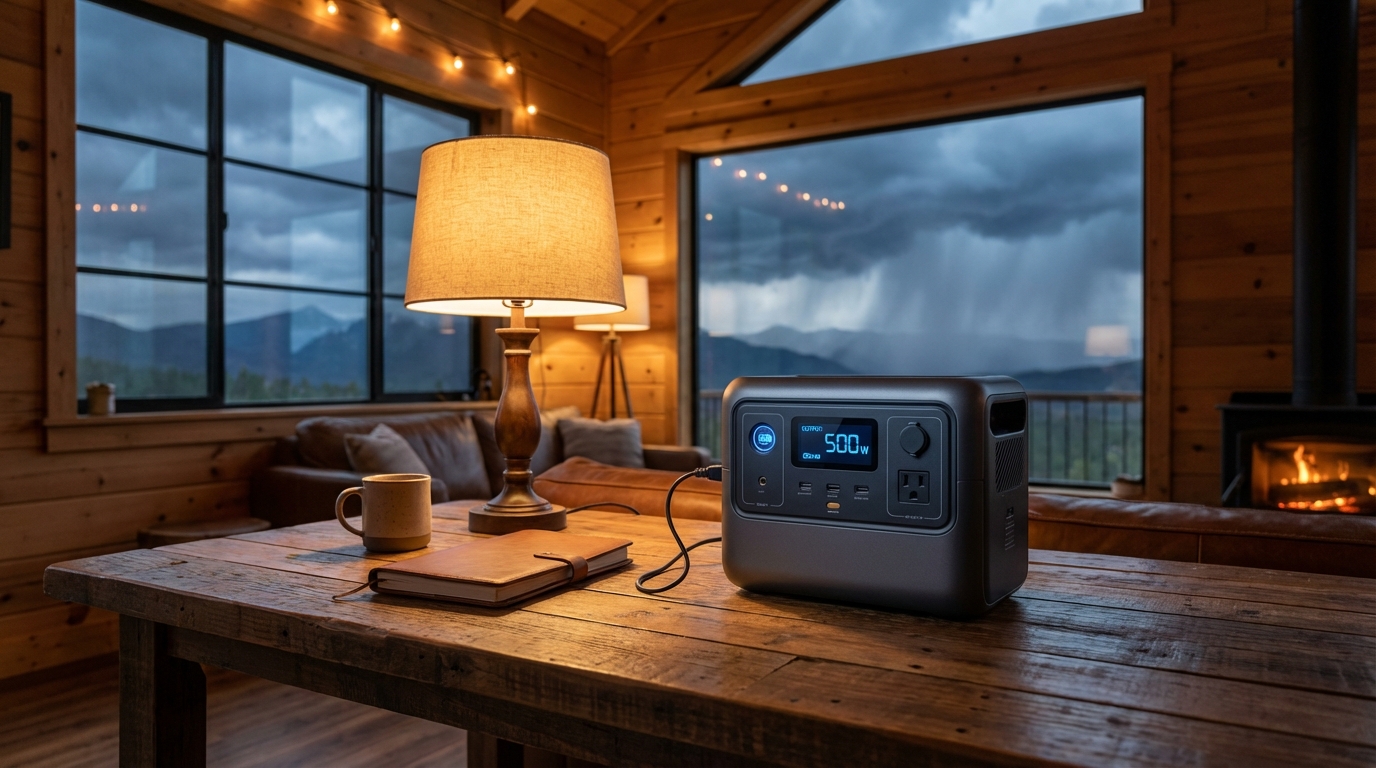
Quick Picks
Short on time? Here are our top recommendations:
- Anker SOLIX C1000 Gen 2 — Best overall
- EcoFlow River 3 Plus — Best budget
- EcoFlow Delta 3 Plus — Best for solar charging
- Bluetti Elite 200 V2 — Best premium
Portable power stations have gone from niche camping gadgets to genuine home energy tools. In 2026, they’re faster-charging, longer-lasting, and powerful enough to run full-size appliances during outages. Whether you need backup power for storm season, a reliable setup for off-grid camping, or just want to stop worrying about blackouts, there’s a portable power station that fits.
Every model on this list uses LiFePO4 (lithium iron phosphate) batteries — the safer, longer-lasting chemistry that’s replaced the older lithium-ion cells. You’re looking at 3,000 to 6,000+ charge cycles, which translates to 10-17 years of regular use before the battery degrades significantly.
We tested models across three price tiers: budget ($250-$450), mid-range ($450-$700), and premium ($1,000+). Here’s what’s worth your money.
What to Look For in a Portable Power Station
Before diving into specific models, a few specs matter more than others when choosing a power station.
Capacity (Wh) vs. Output (Watts)
These are the two numbers that matter most, and they measure different things. Capacity (measured in watt-hours) tells you how much total energy the unit stores — think of it as the size of the gas tank. Output (measured in watts) tells you how much power it can deliver at once — that’s the horsepower.
A 1,000Wh station with 1,500W output can run a 1,500W microwave for about 40 minutes. A 1,000Wh station with only 600W output can’t run that microwave at all — it doesn’t have enough instant power, even though it has the same total capacity.
Charge Speed
Modern power stations charge from wall outlets in under an hour. This matters more than you’d think — if a storm warning gives you 2 hours’ notice, a fast-charging station goes from dead to full. A slow charger might only hit 50%.
Solar Input
If you’re pairing with solar panels (and you should — it’s free energy), check the maximum solar input wattage. Higher solar input means faster off-grid recharging. The EcoFlow Delta 3 Plus leads here with 1,000W solar input.
UPS (Uninterruptible Power Supply) Mode
Some stations can sit plugged into the wall and switch to battery power within 10 milliseconds if the grid goes down. That’s fast enough that your computer won’t even reboot. If home backup is your main use case, UPS mode is a must-have feature.
Our Top Portable Power Station Picks for 2026
1. Anker SOLIX C1000 Gen 2 — Best Overall
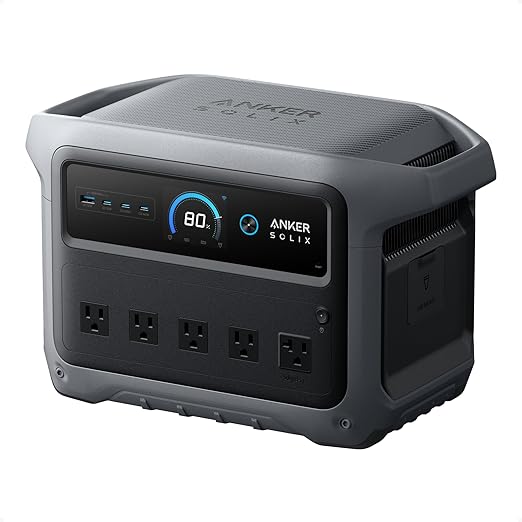
The Anker SOLIX C1000 Gen 2 hits the sweet spot that most people are looking for. At 1,024Wh capacity and 2,000W continuous output (3,000W surge), it handles everything from charging phones to running a mini fridge during a power outage. Full charge in 49 minutes from a wall outlet.
It has 10 output ports — 5 AC outlets, 2 USB-C (one at 140W for laptops), 1 USB-A, and a 12V car socket. The 10ms UPS switchover keeps your gear running when the grid drops. App control via Wi-Fi and Bluetooth lets you monitor charge levels and set schedules from your phone.
At its frequent sale price of around $430 (down from $799 MSRP), this is the best value in the 1kWh class by a wide margin.
Specs:
- Capacity: 1,024Wh
- Output: 2,000W continuous / 3,000W surge
- Weight: 24.9 lbs
- Charge time: 49 minutes (wall), 600W max solar
- Battery: LiFePO4, 4,000 cycles
- Warranty: 5 years
Pros:
- 2,000W output handles most household appliances
- Under 50-minute full charge is class-leading
- 10ms UPS mode for seamless home backup
- Excellent app with scheduling and monitoring
- Frequently on sale for nearly half MSRP
Cons:
- No expandable battery option (unlike EcoFlow ecosystem)
- 24.9 lbs — portable but not ultralight
- 600W max solar input (some competitors hit 1,000W)
2. EcoFlow River 3 Plus — Best Budget
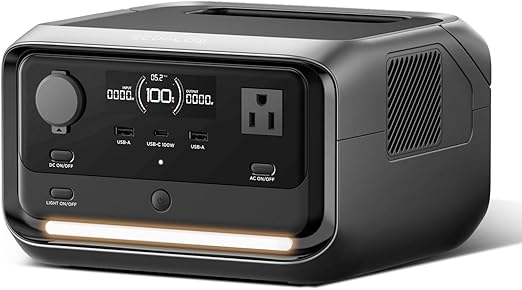
If you don’t need a full kilowatt-hour of capacity, the EcoFlow River 3 Plus delivers impressive performance at 286Wh and just 9.3 pounds. It’s the kind of power station you actually bring everywhere — camping trips, tailgates, work-from-anywhere setups — because it doesn’t weigh you down.
The 600W continuous output (1,200W with X-Boost) handles laptops, drones, CPAP machines, and small appliances. It charges from the wall in about an hour and runs under 30dB — quieter than a whisper. UPS mode with under 10ms switchover is included, which is unusual at this price point.
It’s also expandable — you can add EcoFlow extra batteries to triple the capacity up to 858Wh when you need more juice.
Specs:
- Capacity: 286Wh (expandable to 858Wh)
- Output: 600W continuous / 1,200W X-Boost
- Weight: 9.3 lbs
- Charge time: ~1 hour (wall), 220W max solar
- Battery: LiFePO4
- Ports: 3 AC, 2 USB-A, 1 USB-C, 1 car charger
Pros:
- Ultra-portable at just 9.3 lbs
- Under 30dB operation — whisper quiet
- Expandable capacity with extra battery packs
- UPS mode included at this price
- One-hour wall charge
Cons:
- 286Wh won’t run large appliances for long
- 600W base output limits high-draw devices
- 220W max solar is on the low side
3. Jackery Explorer 1000 v2 — Best for Camping
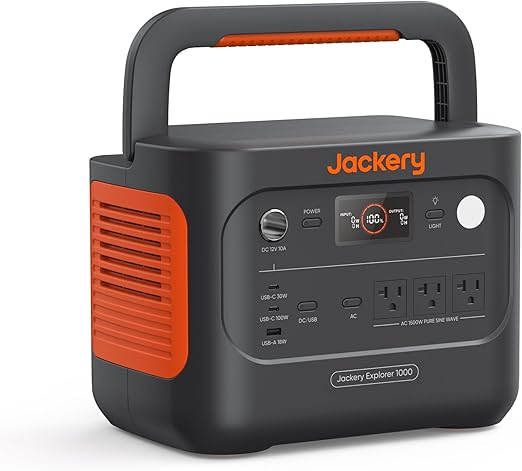
Jackery basically invented the portable power station category, and the Explorer 1000 v2 shows why they’re still relevant. At 1,070Wh with 1,500W continuous output (3,000W surge), this is a proven performer for camping, RV trips, and weekend off-grid use.
The ChargeShield 2.0 technology protects the battery during fast charging and extends its lifespan. The app includes a quiet overnight charging mode — set it and forget it without the fan noise keeping you awake. Build quality is solid, and Jackery’s customer support has a strong reputation.
It frequently drops to the $400-430 range on sale, which is excellent for a 1kWh LiFePO4 unit.
Specs:
- Capacity: 1,070Wh
- Output: 1,500W continuous / 3,000W surge
- Weight: 23.8 lbs
- Charge time: ~1 hour emergency fast charge (via app)
- Battery: LiFePO4, 4,000+ cycles
- Ports: 3 AC, 2 USB-C, 1 USB-A, 1 DC car
Pros:
- Proven brand with excellent reliability track record
- ChargeShield 2.0 for battery longevity
- Quiet overnight charging mode via app
- Solid build quality and ergonomic handle
- 4,000+ cycle LiFePO4 battery
Cons:
- 1,500W output is lower than some competitors at this price
- No UPS mode
- Not expandable — what you see is what you get
4. EcoFlow Delta 3 Plus — Best for Solar Charging
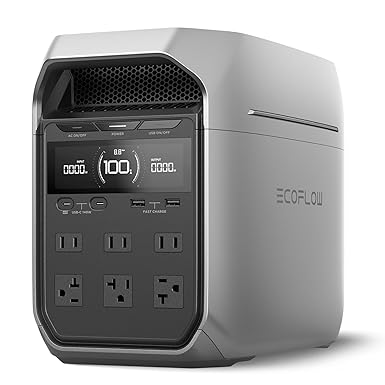
If you’re building a solar-powered setup, the Delta 3 Plus is the clear winner. Its 1,000W maximum solar input is the fastest in its class — roughly double what most competitors accept. On a sunny day with the right panels, you can fully recharge from solar in about an hour.
The 1,800W continuous output (2,200W with X-Boost, 3,600W surge) handles everything short of a full-size AC unit. The IP65-rated battery pack means it’s protected against splashes, dust, and oil — a real advantage for outdoor and garage use. EcoFlow’s expandable ecosystem lets you add batteries up to 5kWh total, turning this into a serious home backup system.
Specs:
- Capacity: 1,024Wh (expandable to 5kWh)
- Output: 1,800W continuous / 3,600W surge
- Weight: 27.6 lbs
- Charge time: 56 minutes (wall), 1,000W max solar
- Battery: LiFePO4, 4,000 cycles
- Ports: 13 outputs including 140W USB-C
Pros:
- 1,000W solar input — fastest solar charging in class
- Expandable up to 5kWh with EcoFlow batteries
- IP65-rated battery (dust and splash proof)
- X-Boost handles appliances above rated wattage
- 13 output ports including 140W USB-C
Cons:
- Pricier than competitors at similar capacity
- 27.6 lbs is on the heavier side
- X-Boost reduces efficiency on high-draw appliances
5. Bluetti AC180 — Best Mid-Range Workhorse
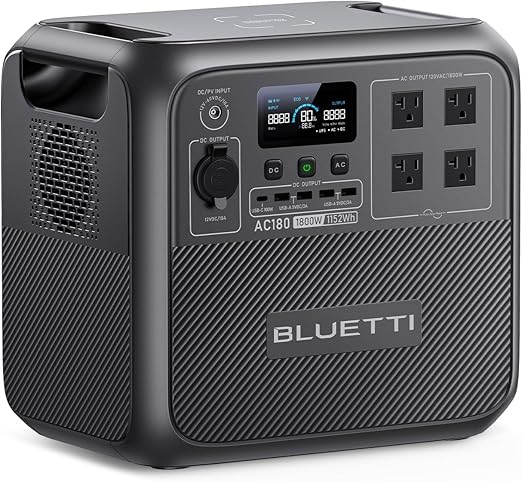
The Bluetti AC180 packs 1,152Wh of capacity — the most in the mid-range tier — with 1,800W continuous output and a Power Lifting mode that pushes it to 2,700W for high-draw appliances. That’s enough to run a full-size blender, small AC unit, or power tools.
A built-in wireless phone charging pad on top is a nice touch that no other power station on this list offers. The AC180 charges to 80% in 45 minutes from the wall and accepts 500W of solar input. It’s also expandable with Bluetti’s B80, B230, or B300 battery packs for extended runtime.
At 35 lbs, it’s the heaviest in the mid-range picks, but you’re getting more capacity and versatility for the weight.
Specs:
- Capacity: 1,152Wh
- Output: 1,800W continuous / 2,700W Power Lifting
- Weight: 35 lbs
- Charge time: 0-80% in 45 minutes (wall), 500W max solar
- Battery: LiFePO4
- Warranty: 5 years
Pros:
- Largest capacity in mid-range tier (1,152Wh)
- Power Lifting mode handles 2,700W appliances
- Built-in wireless phone charging pad
- Expandable with Bluetti battery packs
- Solid 5-year warranty
Cons:
- 35 lbs — noticeably heavier than competitors
- 500W max solar input trails EcoFlow Delta 3 Plus
- Power Lifting mode reduces battery life faster
6. Bluetti Elite 200 V2 — Best Premium
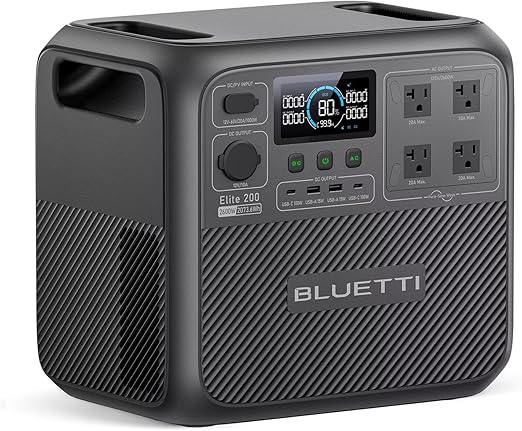
If you want the most power you can get in a single portable unit, the Bluetti Elite 200 V2 delivers. At 2,073Wh capacity and 2,600W continuous output (3,900W Power Lifting), this runs nearly anything in your home — refrigerators, window AC units, power tools, medical equipment. It’s the closest thing to a whole-home backup in a portable package.
The 6,000+ cycle LiFePO4 battery gives you roughly 17 years of daily use. Standby draw is just 10W — three times lower than most competitors — which means it doesn’t drain itself sitting in the garage waiting for an emergency. The 1,000W solar input matches the EcoFlow Delta 3 Plus, and dual AC+DC charging gets you from 0-80% in 50 minutes.
At around $1,100 (down from $2,000 MSRP), it’s a serious investment, but the capacity and longevity justify the price for anyone who needs real backup power.
Specs:
- Capacity: 2,073Wh
- Output: 2,600W continuous / 3,900W Power Lifting
- Weight: 53.4 lbs
- Charge time: 0-80% in 50 minutes (dual charging), 1,000W max solar
- Battery: LiFePO4, 6,000+ cycles (~17 year lifespan)
- Ports: 9 outputs
Pros:
- Massive 2,073Wh capacity — runs a fridge for 24+ hours
- 6,000+ cycles means 17-year battery lifespan
- Ultra-low 10W standby draw
- 2,600W continuous powers almost any home appliance
- 1,000W solar input for fast off-grid charging
Cons:
- 53.4 lbs — you’re not casually carrying this around
- Around $1,100 even on sale
- Only 9 output ports (fewer than smaller competitors)
Comparison Table
| Model | Capacity | Output | Weight | Solar Input | Price Range | Best For |
|---|---|---|---|---|---|---|
| Anker SOLIX C1000 Gen 2 | 1,024Wh | 2,000W | 24.9 lbs | 600W | ~$430 | Best overall value |
| EcoFlow River 3 Plus | 286Wh | 600W | 9.3 lbs | 220W | ~$269 | Ultralight / budget |
| Jackery Explorer 1000 v2 | 1,070Wh | 1,500W | 23.8 lbs | N/A | ~$429 | Camping |
| EcoFlow Delta 3 Plus | 1,024Wh | 1,800W | 27.6 lbs | 1,000W | ~$650 | Solar setups |
| Bluetti AC180 | 1,152Wh | 1,800W | 35 lbs | 500W | ~$499 | Mid-range power |
| Bluetti Elite 200 V2 | 2,073Wh | 2,600W | 53.4 lbs | 1,000W | ~$1,100 | Premium backup |
Portable Power Station vs. Gas Generator
If you’re debating between a power station and a traditional gas generator, here’s the quick breakdown:
Power stations win on: zero emissions, indoor-safe operation, silent running, zero maintenance, instant-on power, solar charging capability, and clean power output that’s safe for sensitive electronics.
Gas generators win on: raw power output (3,000-10,000W+), unlimited runtime (just add fuel), and lower cost per watt for very large power needs.
For most home backup and outdoor use cases under 3,000W, a portable power station is the better choice. You can run them inside your house, charge them from solar panels, and they’ll last a decade or more with zero maintenance. Gas generators still make sense for construction sites, extended outages lasting multiple days, and running very high-draw equipment.
How to Pair with Solar Panels
Every power station on this list accepts solar panel input, making them even more versatile. Here’s how to think about solar pairing:
Match your panel wattage to the station’s solar input. If your station accepts 600W max solar, a single 200W panel will charge it slowly. Two or three 200W panels in series will max it out and charge 3x faster. Don’t exceed the station’s maximum solar input — the station will cap the intake, and you’ve wasted money on extra panels.
Portable folding panels (100-200W) work great for camping and light use. Rigid panels (200-400W) are better for permanent home backup setups where you’ll leave them in the yard or on a balcony.
Most brands sell their own solar panels optimized for their stations (EcoFlow, Jackery, and Bluetti all do), but any solar panel works as long as the voltage and wattage are within the station’s accepted range.
Frequently Asked Questions
How long will a portable power station run my refrigerator?
A typical home refrigerator draws about 100-200W while the compressor runs, but it cycles on and off. Actual average consumption is around 50-80W. A 1,000Wh power station will run a standard fridge for roughly 12-20 hours. The Bluetti Elite 200 V2 at 2,073Wh can keep a fridge going for 24+ hours — enough to get through most power outages.
Are LiFePO4 batteries really better?
Yes, and it’s not close. LiFePO4 batteries last 3,000-6,000+ charge cycles compared to 500-800 for older lithium-ion cells. They’re also more thermally stable (lower fire risk), perform better in extreme temperatures, and maintain more consistent output as they discharge. Every major brand has switched to LiFePO4 in their 2025-2026 models. If you’re buying new, there’s no reason to consider anything else.
Can I use a portable power station as a UPS for my computer?
Yes, if the station has UPS mode with a switchover time under 20ms. The Anker SOLIX C1000 Gen 2 and EcoFlow models both switch in about 10ms — fast enough that your computer, router, and monitor won’t even blink. Keep the station plugged into the wall and your equipment plugged into the station. When power drops, it switches to battery instantly.
How long do portable power stations last?
With LiFePO4 batteries, expect 10-17 years of regular use before the battery degrades to 80% of original capacity. Even at 80%, it’s still very usable. Compared to gas generators that need oil changes, spark plugs, and carburetor maintenance, power stations are essentially maintenance-free for their entire lifespan.
Is it worth paying more for expandable capacity?
If home backup is your primary use case, yes. The EcoFlow Delta 3 Plus can expand from 1,024Wh to 5kWh with additional battery packs — that’s enough to power essential circuits in your home for a full day or more. You can start with the base unit and add batteries later as budget allows. If you’re mainly using it for camping or occasional use, the base capacity of any model on this list is plenty.
The Bottom Line
The Anker SOLIX C1000 Gen 2 is the best portable power station for most people in 2026. At around $430 on sale, it delivers 2,000W of output, charges in under 50 minutes, includes UPS mode, and is backed by Anker’s solid warranty. It handles everything from camping trips to keeping your essentials running during a blackout.
If budget is tight, the EcoFlow River 3 Plus at $269 is the best entry point — surprisingly capable for its size and weight. If you’re building a solar-powered setup, the EcoFlow Delta 3 Plus with its 1,000W solar input is the clear winner. And if you need maximum capacity, the Bluetti Elite 200 V2 at 2,073Wh has enough power to run your home’s essentials through an extended outage.
No matter which you choose, 2026 is the best time to buy a portable power station. Prices are at all-time lows, LiFePO4 technology has matured, and the charging speeds would have been unthinkable two years ago. Pick one, pair it with a solar panel, and you’ve got backup power that pays for itself over years of use.